This past week I have been exploring PageFlakes as a tool for creating a public Personal Learning Network. What makes PageFlakes different from iGoogle or some of the other personalized homepages is that in addition to private pages you can also make a page public or create a Pagecast.
Like many of the personalized homepages, PageFlakes offers gadets, or "flakes", that can accomplish many tasks such as calendars, time zone converters, notepads, discussion forums, and RSS readers.
Will Richardson discusses how to use PageFlakes as a student portal on his blog post here.
Pageflakes
Thursday, December 10, 2009A teacher reflects on blogging as a teaching tool
Thursday, November 19, 2009Leslie Whitaker, a lecturer in the English Department at the University of Wisconsin at Milwaukee posted her recent experiences with using blogs as a teaching tool to The Chronicle of Higher Education's Wired Campus blog today. She had her students blog immediately after watching a live broadcast of President Obama's address during the memorial service for the people killed at Fort Hood earlier this week. She gave them 10 minutes and then asked them to read aloud what they'd written. The results impressed her.
Here is an expert of some of the responses her students gave:
One student, who had family members in the military, wrote a prose poem that started every line with "I hate", including one line, "I hate that my brother lost six years of his life in the Army."What Ms. Whitaker reflected was that by hearing her students' reactions as they shared with each other, made the experience of watching the president's address far more meaningful than if she had watched it with her family or by herself. She also felt that her class was able to give voice to the videly divergent views that exist in our country.
Another student wrote "I have never witnessed the horrors of a murder. To the best of my knowledge, neither has anyone I know. I cannot approximate nor rationalize nor understand the emotions involved, and pretending otherwise seems false. So I am detached."
She closed by posing the following questions:
- Is this what blogging at its best offers us as a society, the chance to put the various slivers of reaction to any complex problem side by side? Or is the process I stumbled upon simply a standard educational model of requiring students to think, write, and then discuss?
- Was 10 minutes too short a time to process a reaction to such a complicated situation? Or is 10 minutes longer than we usually get?"
- I do think that blogging offers us as a global community to put our reactions to complex situations side by side. That's one of the great powerfulness that blogs and micro-blogging tools such as Twitter, allow us to do is respond in a rapid manner as news happens
- I think 10 minutes was long enough. It gave enough time to think it over with too much time to over-analyze it. Would her students have been so brutally honest given more time?
What do you think? I encourage you my readers to post your responses as a comment.
Stages of PLN Adoption
Wednesday, November 11, 2009Last week while researching about PLNs (Personal Learning Networks) for our final project, I came across the following pictures on Flickr, titled the Stages of PLN adoption.
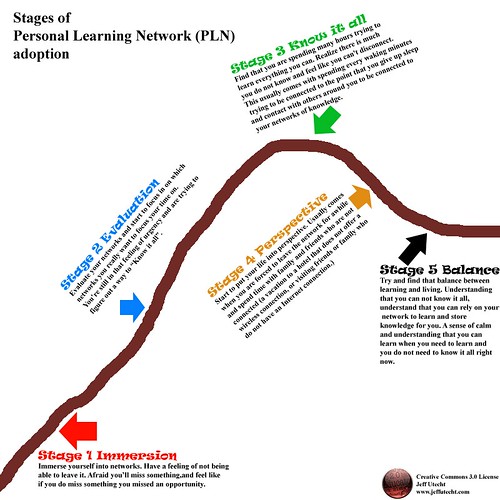
What I discovered is that Jeff Utrecht, who writes a blog The Thinking Stick, wrote a blog post about the stages, in it he lists the 5 stages as:
- Immersion: Immerse yourself into networks. Create any and all networks you can find where there are people and ideas to connect to. Collaboration and connections take off.
- Evaluation: Evaluate your networks and start to focus in on which networks you really want to focus your time on. You begin feeling a sense of urgency and try to figure out a way to “Know it all.”
- Know it all: Find that you are spending many hours trying to learn everything you can. Realize there is much you do not know and feel like you can’t disconnect. This usually comes with spending every waking minutes trying to be connected to the point that you give up sleep and contact with others around you to be connected to your networks of knowledge.
- Perspective: Start to put your life into perspective. Usually comes when you are forced to leave the network for awhile and spend time with family and friends who are not connected (a vacation to a hotel that does not offer a wireless connection, or visiting friends or family who do not have an Internet connection).
- Balance: Try and find that balance between learning and living. Understanding that you can not know it all, and begin to understand that you can rely on your network to learn and store knowledge for you. A sense of calm begins as you understand that you can learn when you need to learn and you do not need to know it all right now.
I also do not believe you have to go through all these stages. Some people jump from stage 2 to stage 5 or do not become so immersed into their PLN that they ever reach stage 3, that sense of having to “know it all.”
I think I'm currently in the perspective stage. Due to current demands in both my personal and professional life I've had to pull back a little bit from the 24/7 feed of information. I haven't looked at Twitter in several weeks and I'm only keeping up on blogs because I've set my feed reader up well.
Subscribe to:
Posts (Atom)

 Posts
Posts


